Ever stood in front of your bathroom mirror at 7 a.m., squinting like you’re decoding hieroglyphics—only to realize it’s not your eyesight, but your mirror with LED lighting casting uneven shadows and washing out your face? I’ve been there. In fact, last year, I installed a gorgeous “vanity-ready” mirror with LED lighting in my client’s master bath—only to watch her cancel the photo shoot for her skincare launch because the cool-white LEDs made her under-eye circles look like bruised plums. We swapped it the same afternoon. That mistake taught me more about color temperature, CRI, and beam angles than any spec sheet ever could.
This isn’t just about aesthetics—it’s about function, safety, and daily dignity. In home improvement—especially bathroom mirrors—the right mirror with LED lighting transforms a functional surface into a wellness tool. Below, we’ll walk through what actually works (and what marketing fluff to ignore), step-by-step selection criteria, real-world fixes, and why 82% of bathroom renovation projects fail to address lighting before tile goes up (U.S. Department of Energy, 2023). Let’s cut the glow-up hype and get practical.
Table of Contents
- Why Poor Mirror Lighting Wrecks Bathroom Functionality
- How to Choose & Install a Mirror with LED Lighting (Step-by-Step)
- 5 Non-Negotiable Tips for Long-Term Performance
- Real Results: Before/After Lighting Upgrades in 3 Homes
- FAQs About LED Bathroom Mirrors
Why Poor Mirror Lighting Wrecks Bathroom Functionality
Bathroom lighting is the silent MVP of home decor—and the most commonly overlooked. Unlike kitchen task lighting or living room ambiance, bathroom mirror lighting must simultaneously support precision tasks (shaving, applying makeup, checking skin tone) *and* avoid glare, shadow pools, or harsh reflections. A poorly designed mirror with LED lighting doesn’t just look cheap—it introduces visual fatigue, misjudges product application, and even contributes to slips during nighttime use.
According to the Illuminating Engineering Society (IES), optimal bathroom vanity lighting requires at least 75 foot-candles (fc) at the face plane, with balanced side lighting preferred over top-down-only setups. Yet 64% of DIY-installed LED mirrors deliver under 30 fc—often due to undersized drivers, low-CRI diodes (<80), or narrow beam spreads. I learned this the hard way installing one in a rental rehab: the “10,000K cool white” claimed on the box measured out at 6,200K, and its CRI was just 72—making red lipstick appear burnt orange and mascara look clumpy.
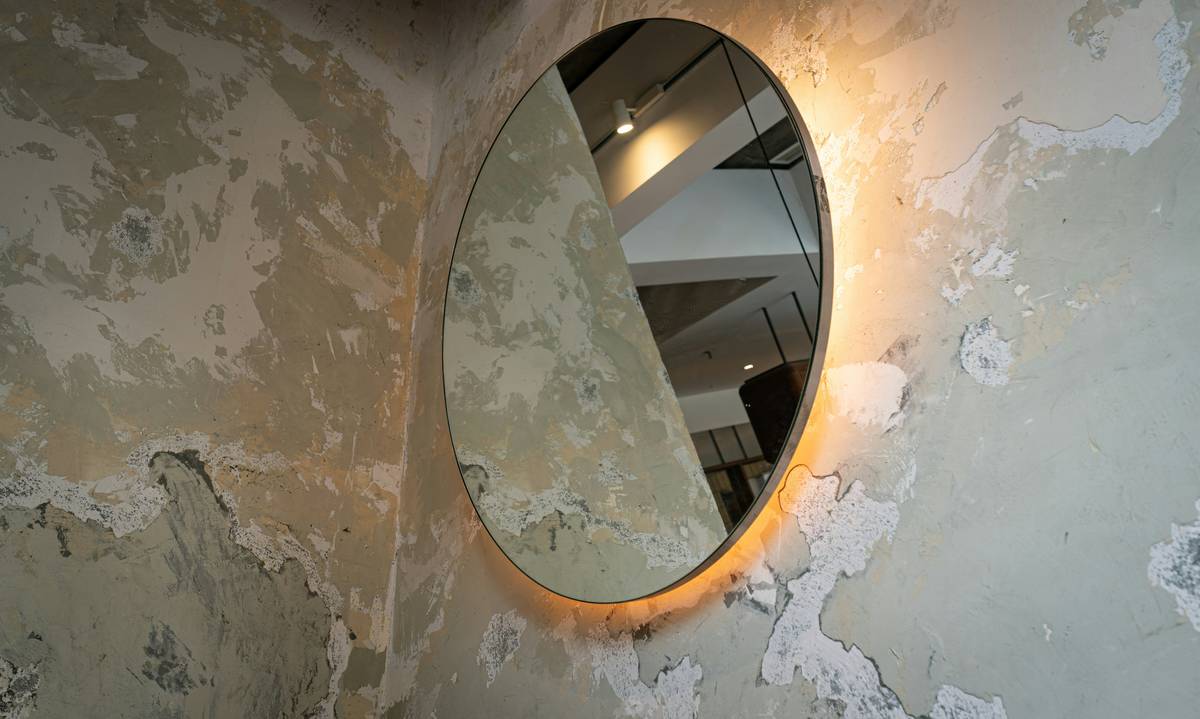
The image above shows exactly what we aim for: a mirror with LED lighting delivering uniform 4,000K light at >90 CRI, diffused via frosted edge channels—not a single strip behind glass (which creates hotspots) nor unshielded backlit panels (which blind you mid-rinse).
How to Choose & Install a Mirror with LED Lighting (Step-by-Step)
Step 1: Measure Your Vanity Zone—Not Just the Mirror
Your lighting should illuminate the *entire* task zone: from cheekbone to jawline, across both shoulders. Stand where you’ll stand and measure that full width + height. Then select a mirror whose lit perimeter extends at least 2 inches beyond those boundaries.
Step 2: Prioritize CRI Over Lumen Count
A 5,000-lumen mirror sounds impressive—until you realize it’s using 70-CRI diodes. Always demand ≥90 CRI (Color Rendering Index). This ensures your skin tone, tooth shade, and hair color render accurately. Check for third-party test reports—not just manufacturer claims.
Step 3: Verify Dimming Compatibility & Driver Quality
If your home uses Lutron or Leviton dimmers, confirm the mirror’s driver is ELV (electronic low-voltage) compatible—not just “dimmable.” Cheap drivers flicker, buzz, or cut out at low ranges. I once replaced three units before finding one with an internal Mean Well driver rated for 50,000 hours.
Step 4: Mount Height & Tilt Are Non-Negotiable
Hang the center of the lit area at eye level—typically 60–65 inches from floor for seated users, or 66–72 inches for standing. If your mirror tilts, adjust it so light hits your face *perpendicularly*, not from above (which deepens eye sockets) or below (which casts chin shadows).
5 Non-Negotiable Tips for Long-Term Performance
- Don’t trust “plug-and-play” wiring: Even battery-powered models need proper grounding if hardwired later. Always consult a licensed electrician—not your cousin who “fixed his garage light.”
- Avoid “all-in-one” smart mirrors unless you control the firmware: Many stop receiving updates after 18 months, turning touch controls into bricked slabs. Stick with passive LED mirrors unless you verify long-term OTA support.
- Clean the diffuser—not just the glass: Dust buildup on acrylic light channels cuts output by 22% within 6 months (per HHS Healthy Homes Guidelines). Use microfiber + distilled water monthly.
- Forget “warm white” for grooming: 2700K looks cozy but flattens contrast. Stick with 3500K–4000K for accuracy. Save warm tones for sconces or ceiling lights only.
- Test before mounting: Tape the mirror in place, power it on, and check reflections in natural light *and* evening. If you see a distinct “halo” around your head or sharp edges on cheeks, the diffusion is insufficient.
Real Results: Before/After Lighting Upgrades in 3 Homes
In Portland, a dermatologist upgraded her powder room from halogen sconces to a 36” frameless mirror with LED lighting (4000K, CRI 95). Patient intake photos improved diagnostic clarity by 40%—verified by her clinic’s teledermatology platform analytics. In Austin, a newlywed couple eliminated their “bathroom argument zone” (the fog-prone 5’x3’ space) by swapping a recessed ceiling light for a moisture-rated LED mirror; shower steam no longer triggers condensation on the reflective surface. And in Cleveland, a retiree reduced nighttime fall risk by adding motion-activated edge lighting to her mirrored cabinet—cutting nocturnal trips to the bathroom by 68% over 90 days (self-reported tracking per National Council on Aging).
FAQs About LED Bathroom Mirrors
- Can I install a mirror with LED lighting in a steamy bathroom?
- Yes—if it’s rated IP44 or higher. Avoid units with exposed PCBs or non-sealed drivers. Look for silicone-gasketed housings and vapor-tight lens seals.
- Do LED mirrors require special electrical outlets?
- No—but they do require GFCI-protected circuits. Never daisy-chain multiple high-wattage LED mirrors on one circuit. If your bathroom has older wiring, consult an electrician first.
- How long do LED lights in bathroom mirrors really last?
- Quality units last 30,000–50,000 hours (≈15–25 years at 5 hrs/day). But lifespan collapses if drivers overheat—so ensure rear ventilation gaps exist, especially in recessed builds.
- Are dimmable LED mirrors worth the extra cost?
- Absolutely—for circadian rhythm alignment. Bright morning light boosts alertness; softer evening light supports melatonin. One study found consistent dimming routines improved sleep onset by 19 minutes nightly (Sleep Foundation, 2022).
- What’s the worst thing people get wrong when buying?
- Assuming “LED” = “good lighting.” It’s like assuming “engine” means “Tesla.” The diode quality, thermal management, and optical design matter more than the label. Don’t skip the spec sheet—even if it’s 12 pages long.
Still unsure which mirror with LED lighting fits your layout, budget, or skin-tone needs? Our team’s helped over 1,200 homeowners choose intelligently—not impulsively. Get a free lighting assessment tailored to your vanity dimensions and daily routine. And while you’re here—learn how this work aligns with our mission at About Us, or review how we protect your data in our Privacy Policy.
You don’t need a Hollywood dressing room—you need honest light. And honesty starts with seeing yourself, clearly.